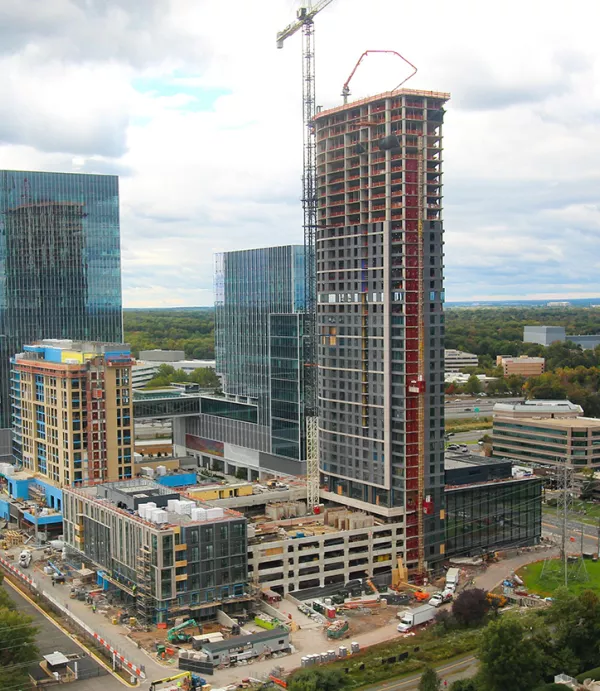
Skymark Reston Town Center is one of the tallest mixed-use residential towers in the Capital Region, with unmatched views that span from the Shenandoah mountains to the National Cathedral in Washington, DC. Located at the corner of Town Center Parkway and Inspiration Street, the project is part of a phased transit-oriented development that expands Reston Town Center in Fairfax County, Virginia.
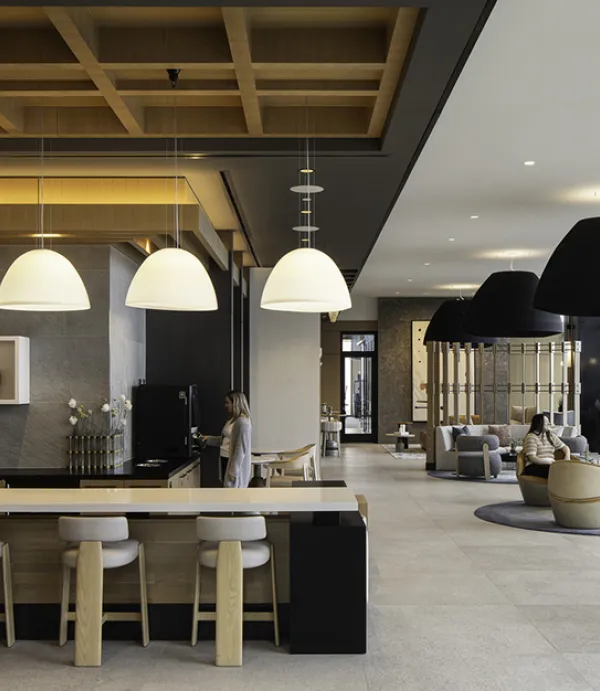
The 39-story LEED Silver development sits on top of a podium containing ground-floor retail, 44 loft-style residential units, and 80,000 square feet of office space across four stories. The tower offers 464 apartments ranging from studio to three-bedroom units, while a low-rise residential building features 44 artisan/maker loft-style units and townhomes with frontage along a new public park. The project also includes 12,000 square feet of active street level retail and garage parking for 630 vehicles. An expansive 5th floor amenity suite bridges both towers. In addition to ample co-working areas, it offers amenity opportunities ranging from a sleek fitness center to a fireplace lounge, all with connections to an outdoor terrace featuring a resort-style pool and deck. A fourth-floor pet spa and bicycle maintenance/storage areas add to the amenity-rich program.
Building Height Complicates Construction Effort
Skymark’s height presented several unique structural and logistical challenges during construction. Large "mega columns" at the perimeter of the floor plate and large shearwalls at the core of the floorplate had to be poured monolithically, requiring detailed planning to ensure the local concrete plant could meet the needs of the large pours. Due to significant wind loading on the tall structure, there were also large, custom-welded steel "link beams," constructed of 4-inch-thick steel plates, that were coordinated with rebar in advance of the concrete pours and beam fabrication. These massive steel beams, which were up to 8-feet high and 13-feet long, were embedded inside the concrete shear walls.
Construction logistics were complicated by limited materials storage areas and above-ground high voltage lines that run in close proximity to the site. Planning of crane picks, such as for precast installation on the North elevation, and tower crane swings, to avoid interference with the high voltage lines, were critically important. The building height and proximity to power lines precluded the ability to set precast above level 24 with a mobile crane. The team developed a solution to set precast on levels 25 to 39 by hand, using chain falls. Locations for chain fall holes were coordinated at the edge of the slab, so the precast could be lowered into place and set. The precast pieces also had to be sized appropriately so that they were not too heavy for the operation – a detail that was coordinated with the precast supplier.